

Behind Nobel-Winning IceCube Science Lies a Decade of SDSC Computing Expertise
Published October 07, 2026
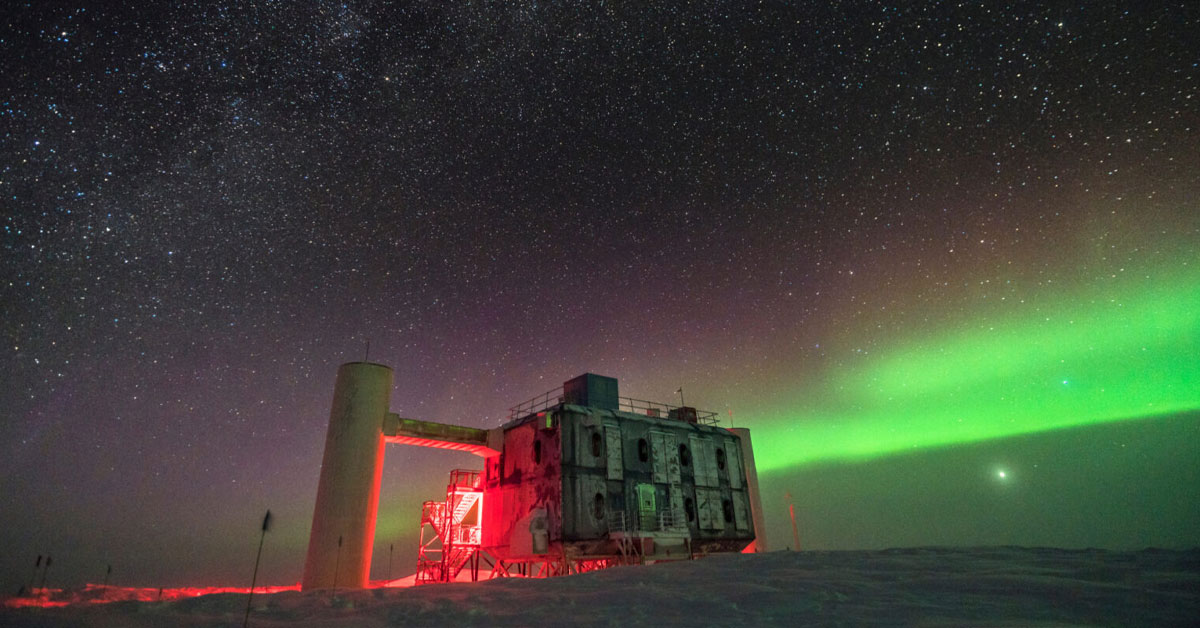
The NSF IceCube Neutrino Observatory. Credit: Martin Wolf, NSF IceCube
A long-standing collaboration with the San Diego Supercomputer Center (SDSC) at the University of California San Diego has helped provide the computing expertise for the search for high-energy neutrinos from space, work recognized this week with the 2026 Nobel Prize in Physics.
Francis Halzen, the University of Wisconsin–Madison physicist whose vision and leadership helped establish the IceCube Neutrino Observatory, was awarded the prize on October 6 “for decisive contributions to the IceCube Neutrino Observatory and the discovery of high-energy neutrinos of astrophysical origin.” The recognition also marks a moment of celebration for SDSC – a division of the at the Halıcıoğlu School of Data Science and Computing – which has partnered with IceCube for more than a decade to advance the computing infrastructure supporting its science
“IceCube’s discoveries depend not only on the detector at the South Pole, but also on our ability to simulate and interpret what it observes,” Halzen said. “For more than a decade, our partnership with SDSC has brought computing expertise and resources to that challenge, helping us turn observations of elusive particles into new insights about the universe.”
At the South Pole, IceCube uses light sensors embedded in a cubic kilometer of Antarctic ice to detect the rare interactions of neutrinos, which are elusive particles that usually pass through matter unnoticed. Halzen first presented his vision for the observatory in 1988. Completed in 2011, IceCube subsequently detected high-energy neutrinos originating beyond our solar system, helping establish a new field of astronomy. Those observations showed that neutrinos could serve as cosmic messengers, offering scientists a new way to study some of the universe's most energetic and distant phenomena.
“IceCube’s discoveries depend not only on the detector at the South Pole, but also on our ability to simulate and interpret what it observes. For more than a decade, our partnership with SDSC has brought computing expertise and resources to that challenge, helping us turn observations of elusive particles into new insights about the universe.”
“Neutrinos are special in that high-energy light is absorbed before it reaches Earth, but neutrinos can travel across the universe largely undisturbed,” explained SDSC Director Frank Würthwein, who holds faculty appointments at UC San Diego in the Physics Department and the Halıcıoğlu Data Science Institute. “A wide range of the most extreme events in the universe can thus be only studied with either neutrinos or gravitational waves.”
Behind that scientific work is a substantial computing challenge. SDSC and IceCube have collaborated on the cyberinfrastructure needed to run large-scale simulations and bring distributed computing resources together for research.
One particularly ambitious demonstration took place on Nov. 16, 2019, when SDSC and the Wisconsin IceCube Particle Astrophysics Center ran an approximately two-hour experiment using some 51,500 graphics processing units, or GPUs, across Amazon Web Services, Microsoft Azure and Google Cloud Platform Supported by a U.S. National Science Foundation (NSF) EAGER grant, the collaboration brought together resources across 28 cloud regions in North America, Europe and Asia to run IceCube simulations.
The “cloudburst” showed how researchers could temporarily assemble computing capacity on an extraordinary scale rather than rely on a single facility. Using HTCondor software, the team integrated the cloud GPUs into one resource pool, allowing IceCube researchers in Wisconsin to conduct simulations to a globally distributed system coordinated through SDSC. The experiment was executed by SDSC scientific software developer Igor Sfiligoi and IceCube production software manager David Schultz.
Explained Wurthwein: “We demonstrated how close collaboration between scientists and computing specialists could expand the resources available for computationally intensive research workloads.”
That partnership extends beyond a single experiment. IceCube’s scientific computing needs have helped inform SDSC’s approach to systems including Expanse, Prototype National Research Platform (PNRP) and Cosmos, connecting infrastructure development with the practical demands of discovery.
As Halzen receives physics’ highest honor, SDSC celebrates both his scientific leadership and the sustained collaboration that helps IceCube researchers pursue new questions about the universe.
Read more about Halzen’s award on the NSF News site.